
Ginger and I had the pleasure of taking a sailing trip with some dear friends, one of whom is also a captain—Captain Nick. During COVID, I trained and received my ocean sailing license with him, and we have since sailed some islands in Tahiti and now St. Martins.
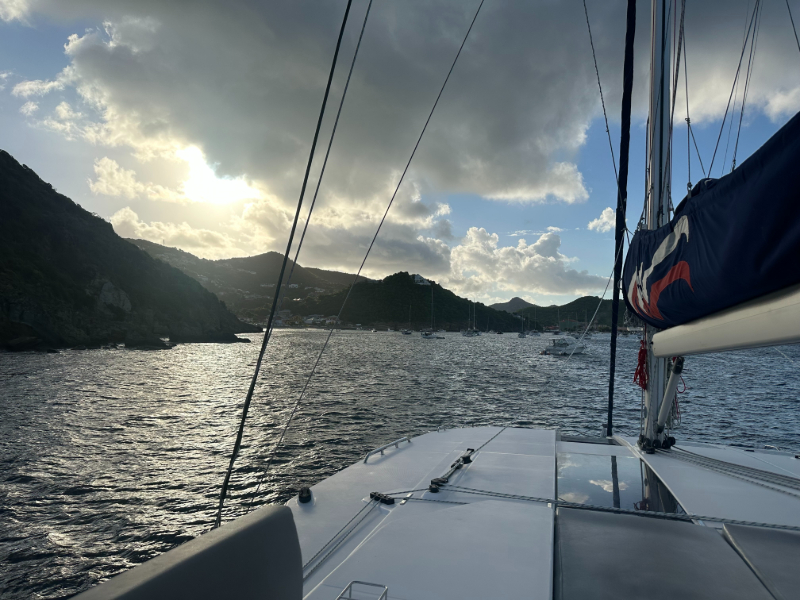
This latest adventure has a life lesson I would like to share. It occurred one night in the harbor of St. Barthelemy (also known as St. Barths), a French speaking island in the Caribbean. We were sailing a 45-foot Leopard Catamaran.
We had spent some hours in the harbor of St. Barth, having sailed there the day before. We were not allowed to pick up a mooring ball (a permanently anchored floating buoy), as they were assigned and reserved, rather we had to anchor ourselves.
When sailing in a foreign country it’s not a good idea to test the waters. There is a process of finding a spot well clear of other boats and setting the anchor by dropping it 5 feet for every foot of depth—that way when the boat swings with the wind, it is well clear of any other boats or objects. In this case, we used all our 120-foot anchor chain for the depth we were at.
After anchoring, we all took our dingy to the island. After returning to the boat after lunch, we were prepared for a nice evening stationary on the water, gently rocking as we had become accustomed to. At this point in time, we didn’t notice anything amiss.
In the late evening the group was visiting inside the gallery-dining area, some playing cards and visiting, and I went outside to enjoy the fresh air. To my astonishment, we were only 10 feet from an adjacent very large sailboat. CLEARLY our anchor was not holding, and it appeared the larger boat assumed a reserved mooring ball, closer to our boat than we had anticipated. It could be that we had not even noticed the mooring ball so close to us when we anchored.
I called for Captain Nick to come look, to which he shouted, “Oh My GOSH,” and we were then all hands-on deck to pull up anchor and reposition. However, it was pitch black except for other boats’ anchor lights which provided no navigation help, but they let us know where they were situated. The captain of the boat we were about to hit was shouting and cussing at us in a language we didn’t understand. Panic ensued. At this same time, we noted our hoisted dingy was nearly capsized with the gas can afloat and the oars falling out. Clearly, it wasn’t properly secured from the last use.
A shipmate jumped into the water and righted it and put the gas can back in the dingy. We lost an oar, but this wasn’t the time to go hunting for it. It’s against the law to sail at night in these harbors for good reasons, plus, neither Nick nor I are authorized to sail at night.
With scores of boats moored and anchored, we began to troll around hoping to find a spot. There were NO available spots, and we were in peril, navigating around anchor lines and other boats. The current was strong and it was hard to hold a straight line even while trolling.
Due to night sailing restrictions, we were not authorized to sail to another harbor. All hands were on deck, someone on each corner of our boat with flashlights, and one shipmate manning the anchor, with Captain Nick at the helm. We tried to drop anchor again, but it didn’t hold, and we snagged someone else’s mooring ball line. The anchor man pulled up anchor and untangled us. Some were shouting that we were about to hit other boats, even though we seemed well clear, Captain Nick’s head was on a swivel, listening to all the barking and pointing and trying to not crash the boat or ground it. It was a bit chaotic.
I was running from bow to stern and starboard to port trying to direct traffic. We were not about to sink, but we were endangering ourselves and others. We were adrift without a home. During this time of chaos, Ginger went below deck and uttered a prayer for angels to assist us. We know of others (if not everyone) who uttered prayers in their heart while at their posts.
THEN, a little man in a striped shirt came in his dingy and started to yell at us in French. He was trying to figure out why we were roaming the harbor at midnight, putting others in danger and clearly not finding safety. COINCIDENTALLY, two of our shipmates spoke French. Our French speakers spoke to the man and told him we were sorry and didn’t know what to do. He softened and instructed us to follow him to his boat, which was more protected from the winds and said we could anchor behind him. He flashed his hand-held light, and we slowly followed him.
When were close to his boat, he came to us in his dingy and came aboard. He came to the bow and helped us anchor, but he did it in a different way than we were accustomed to. In the past, we would put the engines in reverse after anchoring to set the anchor. Problem is, in sand, the anchor would just be pulled up by the powerful engines. The Frenchman instructed us through our interpreter to NOT reverse the engines, and instead, he put his hands on the anchor bow and “felt” for the tugging while pulling back on the lines; allowing the wind and current to set the anchor. He knew when the anchor was set by feeling the line. He knew the tension. His experience was what mattered most.
We were all relieved and thankful for this angel who came from nowhere to help us. Our anchor man stood up from his anchor chain duty and gave the man a hug—so filled were we with gratitude.
After the ordeal ended and we were safely anchored, Captain Nick called the crew together to thank everyone for their efforts and was proud of how we all pulled together. While our lives were not in danger, we still were adrift and wandering, looking for a new home in the black of night. It took the entire team to make it all work, those holding the lights, those keeping watch on all corners, those manning the anchor and chain, those praying for angels.
He then motored back to his boat in front of us. In the morning, I arose at dawn as is my custom and sat on the upper deck to meditate. I looked to the portside and saw that we were only about 50 yards from large cliffs and a rocky beach (which we could not see at night), which was a good wind break and did provide a safe harbor.
The next morning, Captain Nick and Masha his wife took a gift to the man who saved us. The picture shows him in his striped shirt with Nick and Masha.
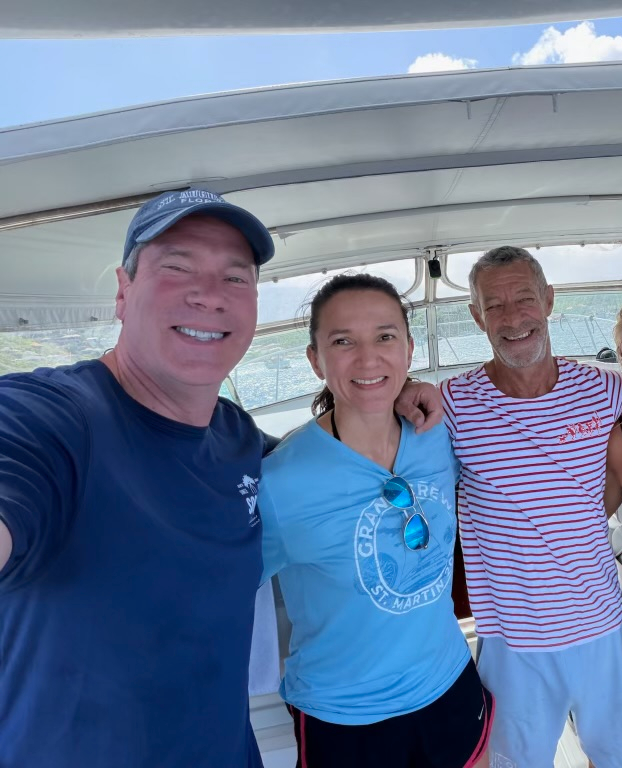
Turns out, he lives on his little boat for ten months of the year in this harbor as rents are too expensive to stay on land, while he takes his dingy to work every day at a hotel on this island. He goes home to France for two months of the year
Here are the miracles and lessons learned from the St. Barth anchor crisis:
- It was no coincidence that Ginger prayed for an angel, and others prayed for help at their posts. We believe in angels.
- It was no coincidence that we had TWO French speakers on board to communicate with the angel God sent to help us as he spoke only French.
- Once we are “anchored” in life, we need to keep in mind, that the situations change around us. The wind and current change, and the soil which we are anchored in can change.
- If we pull too hard on the anchor, we can unmoor ourselves and find ourselves adrift. We need to frequently check our anchor to assure it is solid, and we are not adrift. If it seems we are moving or slipping away from where we ought to be, we need to make adjustments.
- Know that everyone finds themselves unmoored in life—we all need angels to redirect our paths. Count on angels and count on God sending them.
- Sometimes we just have to adjust our anchors by the “feel of it” all other formulas notwithstanding. Listen to your inner voice.
- A great leader will always rally the crew and find the good.
- Finally, IT NEVER HURTS TO SPEAK FRENCH!