All posts by mike

The Power of Silence – Keeping Embers of Hope Alive

October 19, 2022

A pastor noticed that a parishioner had stopped attending his services.  The parishioner evidently felt he was no longer noticed, loved, or missed by his attendance, so he simply stopped coming.

The pastor gave it some prayerful thought and paid a visit to the elderly man on a very snowy and cold winter day.  He knocked on the door.  The man opened the door, and they had a cordial greeting, but beyond that, neither said a word. 

The man motioned to a chair to join him by the fire. After a good time of only the sound of wood and coals crackling and feeling the warmth of the fire, the pastor picked up the fire prod and began poking at the coals.  He moved a glowing coal away from the fire.  They both sat watching as the coal lost its heat and eventually stopped glowing.  Several minutes went by in silence.  Then, the pastor pulled the coal back to the edge of the fire as they watched it rekindle and glow again, adding heat and luster as the glowing embers glistened off their warming faces. The pastor put the prod down, tipped his hat and walked to the door and let himself out. 

The following Sabbath, the man returned to the congregation.  The pastor welcomed him by name and asked what brought him back.  The man said “Pastor, at my home by the fire, you gave the best sermon I’ve ever heard you give without saying a word.”

This story I recently heard is directly relatable to the epidemic of anxiety and depression in our world today, especially among our youth.  Feelings of anxiety and depression often lead to isolation. The healing process is a two-way street.  Those who notice the dying ember must reach for it and bring it back into the fire.  Those who are the dying ember must allow themselves to be open to authentic outreach and be willing to be moved (both on their own and by the love of the community).

The question is how to begin this outreach.  One of the more evident answers is to do as the pastor did, and not say a word—just listen and be there for each other.

In his book, Happy Mind Happy Life, Dr. Rangan Chatterjee articulated 10 rules for listening to others.

  1. Be non-judgmental.
  2. Be curious.
  3. Practice true sympathy: not “I know how you’re feeling,” but, “I don’t know how you’re feeling but I am here for you.”
  4. Take time to really listen; don’t just think about the next thing you’re going to say.
  5. Show them you are listening with your body language—posture, tone of voice, eye contact, not being distracted by your phone.
  6. Don’t try to predict where the conversation will go next.
  7. Embrace silence.
  8. Repeat back what they’re saying in your own language.
  9. Don’t try to fix them or rush in to tell them what you would do.  Instead, try asking “How did that feel for you?” and then actively listen without interruption.
  10. Have no attachment to the outcome of the conversation.

There are also keys for listening to ourselves and surrounding ourselves with people in selective circles of trust. Parker J. Palmer, talks about developing circles of trust in his book, A Hidden Wholeness.  Not surprising, he notes both the need for companionship and community in our journey, as well as being able to live in silence to effectively “listen” for our inner voice.  He writes“….We all have an inner teacher whose guidance is more reliable than anything we can get from a doctrine, ideology, collective belief system, institution, or leader.”  

Becoming acquainted with our inner voice (or teacher) is essential.  Though it is a unique voice for each of us, it still requires community for our inner truth to leave isolation.  This journey toward inner truth, he said, is too taxing to be made solo, too deeply hidden to be traveled without company, and needed to find the courage to venture into alien lands (a new life of fulfillment).

The space we make to discover and listen to this inner voice is highly individual.  No two people may take the exact journey, and that is the beauty of discovering our inner voice It is OUR personal teacher—no one else’s.  It is OUR personal tutor and speaks only to us if we are listening.

For me, finding my inner voice requires peace.  In some recent travels I had a chance to compare total chaos in a busy city to the absolute peace of a secluded lake.  What was the difference between them?  The city was a cacophony of noise with masses of people like salmon swimming upstream. While at the lake, I could sit and hear myself breathe as I viewed the large expanses of mountains and water.  The silence around me brought the peace I was seeking, and my inner voice began to speak to me.  Those trusted friends who were with me were kind enough to watch me breathe without saying a word, until I was ready to reveal some of what my inner voice was telling me.  I extended the same courtesy to them.  This became a beautifully healing experience.

In all my research and lived experiences dealing with these issues, I’ve felt simple observations and suggestions like these are helpful.  The formula that works for me in lowering my anxiety and limiting bouts of depression are these:

• Find a place for peaceful silence without being too isolated; a space to hear the inner voice guiding your next steps. 

• Be with trusted friends and family who have the skills to listen, really listen (sometimes without saying a word), and to enjoy the warmth of their figurative fires to keep the embers of hope alive. 

• Practice the art of listening as you figuratively reach for the fire poker and gather in the dying embers to ignite hope.

Evolution requires reflection.  I hope as you reflect on the impressions of the inner voice, ponder the story of the dying ember, and commit to a being a better listener, you will discover ways to be reignited and experience the glow and warmth you truly deserve.  

Repeat or Evolve – From Focus to Flow (Part Two)

June 29, 2022

In part one of this two-part series, we learned a few steps to increase our focus and purpose in this world of information overload and multi-tasking. In part two, we will dive deeper into the mechanics and disciplines that extend our focus and purpose to a higher level.

The Psychology of Focus

When I left Wyoming to pursue other interests, my mother was distraught. She wanted me to stay on at the bentonite plant until I could be hired by the oil industry where my father and brother worked. In her mind, this was my destiny. I totally respect those who have worked hard in the oil fields, and for many families tied to this industry this is the path to success. This is what they know, and their world other options are not imaginable. At least, that was my mother’s way of thinking.

Many people follow a path of familiarity, because “it’s always been that way.” Traditions become truth, and sometimes these traditions can limit our ability to gain deeper truth and also limit our discovery of how to bring purpose and real joy into focus.

In the early 1980’s, the Harvard professor B.F. Skinner was famous for his study of human behavior. He found that you could train the focus and attention of animals by reinforcing behavior. If a pigeon lifted its wing, and the response was to feed it, that behavior would repeat itself if there was a reward. Skinner suggested that free will was an illusion, believing that human action was the result of conditioning. He believed what he learned from the animals could be transferred to human psychology.

In fact, this type of instant reinforcement is now used by social media companies whose users number in the billions, getting their instant rewards for their actions.  But instant gratification and reward doesn’t always transfer to an ability to focus and think deeply.  In fact it can subdue them.

Mihaly Csikszentmihaly came to America challenging Skinner, believing there had to be a more positive explanation to the psychology of behavior. In part of his study, he observed a group of painters in Chicago working on their paintings patiently for hours on end. He observed that creative people were not so interested in the rewards, but rather the outcome of their work was more important. He observed other groups of people in other activities that required long-term focus, like chess players and rock climbers. He discovered that focus was a result of “flow” and created the concept of “flow state.”  This happens when a person becomes so absorbed in that which they are doing, it carries them forward with pleasure.

Mihaly discovered, not surprisingly, that distraction and multi-tasking kill flow.  Flow can only be achieved through monotasking. Choosing this path of flow requires a clearly defined goal, with meaning to you behind the goal, and working to the edge of your ability.  If the goal is too easy, we go on auto pilot, but if it’s too difficult, we become anxious and do not strike the balance of flow state.  As we progress in our abilities, the edge of our abilities also moves forward, but we need to be in a flow state to get there.  This pocket is a recognizable mental state where we become one with the task. 

When I flew airplanes, I could have the controls in my hands and could feel every axis of the flying experience, or I could put the airplane on auto pilot.  On autopilot, I would easily forget about the immediate tasks of flying; but it didn’t take me to the edge of my abilities.  Interestingly, no pilot keeps the airplane on auto pilot all the way to the runway.  At some point they must have had the experience of having the controls in their hands and knowing exactly how to absorb the conditions around them to fly safely to the ground.  In this flow state I would become one with the airplane – a joyful experience.

The Skinner approach suggests rewards at each step of the process, but does not allow the space to enter deeper focus. The Mihaly approach allows the focus to be derived from the goal and passion, rather than the conditioning for results method of thinking. The Skinner theory rewarded learned behavior sometimes at the expense of focus, while the Mihaly theory discovered the pleasure and joy people experience during periods where focus is fully absorbed. This makes sense to me when I think of the few times my focus was so centered, I really did enter a new dimension and I evolved.

The challenge of our day centers on this question “How do I change my focus to that of a flow state, rather than a “click and switch” lifestyle”?

Here are three considerations to achieve a higher degree of focus and purpose:

1. Get your sleep. The National Sleep Foundation has found that 40 percent of Americans are chronically sleep deprived. Even during off hours and what would normally be sleeping hours, employers now commonly ask their employees to be accessible and expect them to respond to their devices like Pavlov’s dogs. Once the device goes “ding” and the screen comes to life, it takes another 20 minutes minimum for the senses to quiet themselves to achieve sleep.

A lack of sleep destroys the ability to focus, deprives one of creativity, and doesn’t allow one to enter the deepest sleep which heals and restores. You can’t cheat your way through lack of sleep with caffeine or other substances; these stimulants have their own set of damaging issues. 

2. Learn to read again. Gallup found that 57 percent of Americans now don’t read a single book from cover to cover in a single year. Though I read around a hundred books a year – the real hold in your hands books – I find most of my friends either listen to books or read them on devices.

Apparently, the way we read books makes a difference.  Johan Hari in his book Stolen Focus, interviewed Anne Mangen, a professor of literacy at the University of Stavanger in Norway who performed a two-decade study on this.  She found that reading on screens causes us to read differently, with more tendency to skip and skim and not dive deep into the pleasurable immersion of reading from a book. Her research from fifty-four studies has labeled the difference as “screen inferiority,” which concludes that reading on screens diminishes understanding, retention, and the pleasure of reading.  All told, it reduces our ability to focus.

3. Redefine Prosperity. Consider what prosperity means to you. We live in a world where financial wealth and growth is the litmus test for success. If the companies we work for do not grow, we don’t prosper.  Financial wealth aside, If we don’t grow personally, we don’t prosper either. This is where the attention to improving our focus comes in.  In my view, real prosperity isn’t the balance in your checking account (though that can help), rather, it’s the measure of your joy and peace.  It’s the measure of the love that surrounds you.  Personal growth then requires a deeper measure of focus, which in turn increases the reservoir that defines true prosperity.

Imagine a world where we spend more quality time with family, get enough sleep to be restored and healed every night, spend enough time and focus on our flow states, limit our intake, slow our roll, and learn to read again. This is the world I want to live in more fully. I am using these steps to enter and stay in that world. If these are your desires also, I invite you to join me in this journey.

Repeat or Evolve – How to Gain More Focus and Purpose (Part One)

June 6, 2022

So much information bombards our minds these days. We absorb more information than ever before. Let me re-phrase that. We are fire hosed with more information than ever before, but we actually don’t absorb any more – UNLESS – I’ll get to that in a moment.

In my early married life I had a job at a bentonite factory. I swept the floor from one end of the plant to the other.  I would dutifully sweep in one direction, only to look back and see about the same amount of dust had accumulated on what I had just swept. Then I would turn around and repeat the process. 

I hated that job.  But in my mind it was a means to an end.

After a particular hard day at work I walked out from the plant in boots and mud and my wife picked me up.  She announced as I hugged her, that she was pregnant with our first child, AND, there was no way she was having our baby in Lovell, Wyoming.  At that moment I became acutely aware of my situation and my responsibility as a husband and future father, and I made a conscious decision. Just like Jed Clampett, we loaded up the truck and moved to California.

It was that experience that pushed me forward, out of that plant and into something that caused me to evolve. 

Dr. Roger K. Allen, an expert on personal transformation, says we are not “locked in to earlier decisions; re-deciding requires that you be aware, take responsibility…and then act from a conscious decision.”  The writer James Baldwin opined “Not everything that is faced can be changed, but nothing can be changed until it is faced.”

The process of moving forward with intention, regaining focus and purpose, or in other words evolving, is not an easy process. Evolving, rather than running on the same hamster wheel all day and repeating, requires intentional decisions. Intentional decisions require focus. HOW to focus amid all the information and distractions is the question. Here are a few observations that may help.

Four Steps To Achieve Greater Focus and Purpose:

Limit the intake. Limiting the intake from the firehose of information available brings with it the usual dangers of detoxing from any other addictions. Often a chasm forms that must be bridged to move forward.  It seems like an oxymoron at first, limiting the intake to move forward. Let me explain.

I had one of the very first car phones (before personal cell phones).  Proudly mounted on my dash, it was a small phone booth-type telephone inside my car. The world became smaller. This was the beginning, I’m almost embarrassed to say, when the world of instant data coming from all directions was not only addicting for me, but it filled the voids of my own loneliness. My focus diminished, but my knowledge of many things was expansive.  I joined the hollow world of becoming a star in my own space. I was a “big deal,” and this mounted phone booth in my car proved it. 

This self-made blanket of security, which built each year to circa 2015,  was suddenly ripped away when I was fired from the company I had built and sold, exposing me to the real world and causing within me an identity crisis. It would, however, become an opportunity for growth and self-reflection. My cocoon of self-made narcissism had to be cracked open to let the butterfly within me get wings to fly. 

Limiting our intake of the noise surrounding us is key to learning the art of focus. It might take a sudden reality adjustment. But the process of detaching from the daily firehose must start.  If we can discipline ourselves regarding this intake of information and fake self-worth, we can then absorb the best life has to offer. For example, putting the cell phone down for dinner with the family, a movie, or a drive with your loved one is a small but important start. Even in church, I observe many people on their cell phones during the service. How did we get here?

Any detox has withdrawals and challenges. But control over the intake is key to evolving and not repeating the same processes of reaching for information every few seconds.  Being unplugged makes the brain think again and the initial blank space is soon populated with the color of a new palette.  

Learn the art of focusing. A recent study found that the average American college student switches tasks every 65 seconds. Adults in an office can only stay on a task for three minutes. This challenge of focus has been going on for centuries, but it has been accelerating in our time. In Johann Hari’s best-selling book Stolen Focus, he wondered if the motto for our era might be “I tried to live, but I got distracted.”  He notes that Professor Michael Posner at the University of Oregon found that if you are distracted, it takes on average 23 minutes to return to that focus. How many times are you distracted in a day? How many minutes are lost?

Understand that “multi-tasking” is a myth. It was invented to help computers. But then it was applied to humans, thinking it would be successful. Professor Earl Miller at MIT discovered through his research that we can only focus on one or two thoughts in our conscience mind at once. It was found in a study commissioned by Hewlett-Packard, that multi-tasking, can lower your IQ by more than ten points. This practice of multi-tasking is also referred to as “switching.”  If you do this, you will be slower, make more mistakes, be less creative, and remember less of what you ought to be focused on.

Slow the roll. Guy Claxton, a professor of learning sciences at the University of Winchester, analyzed what happens to a person’s focus if they deliberately engage in practices such as yoga, meditation, or other like practices that, as he puts it, “shrink the world to fit our cognitive band width.” Slowing our roll nurtures attention and focus, while adding speed shatters it.

I recently joined a group on a sailing trip. Our cell service was spotty, and we were “forced” to slow our roll. What happened? We visited, we read, we had meals together, and played card games at night. We had time to star gaze and ponder life. We nurtured things that otherwise were lost in our hamster wheel world. While sailing, it was impossible to multi-task as our attention was focused on the wind, the sails, the charts, and all that is required to not become shipwrecked. It was a detachment of real proportions from the world we live in.  Magic happens when we slow the roll. We gain focus, get smarter, and gain a portion of this asset we call uninterrupted time.

Remove the mask and reveal yourself. You cannot evolve behind a façade. Our social media world creates a nagging sense of hollowness.  As you detach from social media’s intended addictive conditioned behaviors, and your detox begins, it can create an absence of meaning. My friend who put himself through this detox found that the lack of all the texts, instant messages, emojis, likes, hearts, etc. were devastating—initially. Gradually, without the social web there to tell him how wonderful he was, he realized the shallowness of the substance he had previously counted strongly toward his self-worth.

We will continue this idea of increasing focus and purpose in part two of this series as we learn more about evolving, gaining focus, and purpose. Until then, if we can gain 20 percent more focus and become more fulfilled and happier as a result, isn’t it worth the effort?

More Desert Time: A Guide to Modern Day Peace – Part Two

February 15, 2022

In part one of this two-part series, suggestions were made for finding our own peace in this crazy world.  Finding our own “desert,” or inner peace, requires significant effort.

My wife and I are building a new home. The outside of the home has a number of stone columns.  They are large and require significant skill to put the puzzle together.  Several things must occur to make it right.  First, a wire and scratch coat must be put on for the stone to stick.  Then the stone needs to be cut and put together perfectly.  Then there is mortar put between each joint, squeezed in with a bag.  The mortar needs to be the right mixture to stick, provide support, and be the exact color contrast to make the stonework pop. Outside temperatures need to be within certain parameters for best results.  

I thought of how shaping a world of peace is like the stonework I’m witnessing by two meticulous stone masons. We need to start with basic routines and lay the groundwork for our efforts.  This process is only the beginning.  If we left our work there, our peace would be fleeting.  Then we add to our routines and rhythms, stone by stone—each one different but adding value to the whole.  Each must serve a purpose and build on one another.  Customization is the key.  Then we review the patterns over and over, like putting mortar in the spaces, to make it long lasting and beautiful.

In our building of these patterns, routines, and rhythms of peace, the timing of it all is important.  In part one of this series, we talked about the phases of life we are in and how that applies to how our intentional shaping of our lives are fashioned.  In the Monastic world, when the bell rings, the monks drop everything they are doing to do whatever it is time for.  Managing our time and what we do with it means everything. In distinct phases of our lives, we listen for the monastic bell. 

While raising children, for example, time is seldom our own, and we put our own needs in second place as we serve our children at each sound of the bell.  This space with our children is our own domestic monastery.  Doing whatever it is “time to do” is paramount to achieving purpose and peace. 

Perhaps we have a time each day when our monastic bell rings and we drop everything to, for example, enter our sacred space to meditate on the important questions of life.  Finding this space and answering the bell will require both intention and risk.

My late son had this experience in Europe to begin a journey that established his space apart and a journey of intention.  He wanted to go to Switzerland, the land of his ancestors, to get answers to some of his deepest questions.  He felt strongly that in this land would be his sacred space. As his journey began, he was faced with detaching from some of his “old mindsets” to allow new soil to be turned. Here is his journal entry about it:

“My relationship with money changed in a way I never anticipated it would.  I’ve finally become detached from my money.  The feeling I’ve had to hoard money is now gone.  The turning point came in the middle of the train reservation office at the Basel SBB Train Station.  I was dealing with a very “not nice” person and it came time to hand over my debit card.  I broke out in a cold sweat.  My sweet, sweet money was gone with the swipe of a mean travel agents’ chubby hand.”

In this example, Skyler felt tethered by his money and feared losing it. This experience released him from this fear and allowed him to move forward in a way he hadn’t known was possible.  With this as a backdrop, let me share some of the insights I’ve gained from time in my own desert:

  • Be intentional:  Don’t just go through the motions of life.  Take some risk.
  • Give yourself permission to be alone, with your thoughts, away from the electronic devices.
  • Find your sacred space and enter your own desert. don’t let all of your time be consumed by what others are imposing on you.
  • Don’t spend time worrying about things you have zero control over, Remember, anxiety is largely a fear of the future.  Live in the present.
  • Do something that makes a difference even if you aren’t feeling like it, such as spending a morning texting gratitude to those you love.
  • Understand time is not just your own. Listen for the bell.
  • Find the rituals and rhythms that move you toward peace and purpose. Like our stone mason, carefully select the stones and apply them to our pillars of peace to customize our path and inculcate the lessons learned from our personal desert.
  • Read good books often and broadly. Enlarge your space. These could be a part of the stones that make up our pillars.
  • Create your own questions and record your insights.

Enjoy your “desert” as you enter this space of discovery which leads to empowerment, purpose and peace.  The inspiration you find in your own desert will shape the foundation and beauty of the pillars of peace you are building.  These pillars support your newfound peace and freedom, and serve as a wall of sorts to keep that which is not sacred out of your personal desert; anything that would distract from the beauty of it.

More Desert Time: A Guide to Modern Day Peace – Part One

February 8, 2022

I have written much about suicide ideation since the passing of our dear son in August 2020.  Mental health is a topic that should be front and center in all our minds and hearts, not just for those who know loved ones and friends who have succumbed to the demons of the day.

Living through and above anxiety and depression is easier said than done in our world of chaos.  There is so much noise that becomes a cacophony of voices and choices. But finding purpose and peace will crowd out the noise and give us hope for a better day.  We can learn to LIVE and not just exist, in these days of confusion.

Since Skyler’s passing, we have doubled down on our mantra of “doing some good every day,” and to live life more intentionally.  This was his mantra as well, and I would like to expand on his vision as I outline suggestions for modern day peace.

In my studies of Monastic monks and those who have dedicated their lives to discovering their identity, I have found keys to create the peace and abundant life we all seek.  These keys apply to everyone, whether you consider yourself to be spiritual, religious, non-spiritual, non-religious, secular, or atheist. All can benefit. 

In His book Letters from the Desert, Carlo Carreto, an Italian Catholic Jesuit youth advocate, was very busy doing wonderful things.  Still, he felt he hadn’t really made the connection with God he desired.  So, in his mid 40’s he left for the desert to find his center.  He left his entire life and friends behind and spent ten years in the desert of Northern Africa with a few of his “Little Brothers,” living as monks, to discover answers to his deepest questions.

For him to leave his busy and seemingly fulfilled life behind in this way is an inspiration to me and has made me desire to go to my own “desert” to gain answers to my own questions. I have also discovered that this process is ongoing, not a ONE AND DONE event.  In this way, as we find the rituals and rhythms that elevate our souls, peace and purpose expand in our daily lives.

Experiencing peace begins with finding our sacred space.  For Carlos, it was the desert in Northern Africa, for us it will be wherever we decide. This becomes our symbolic desert.  For example, I have two spaces that invite the meditation and reflection needed to grow my peace and focus my purpose. One is my one hour walk in the hills of my town each morning, and one is my office, where I am surrounding by many friends (books).  These spaces are symbolic of my own monastery, a place set apart. 

In their monasteries the monks prepare questions that invoke deep thought and meditation.  These questions are answered over time as we invoke our own “monastic routines.”  Let’s consider questions we might ask in three phases of our lives.  Your questions may be vastly different, but you will get the idea.

Phase One

Who am I?

What will I do with my life?

Who loves me?

Who will marry me?

Where should I live?

What should I do?

Of course, these questions are foundational to establishing a life of purpose, but as we mature in years, there are other questions:

Phase Two

How will I remain true to who I am?

How do I sustain myself in the commitments I have made?

How do I turn my focus outwardly to bless the lives of others?

And then, if you are in the phase of life I am in (retirement age) you might ask:

Phase Three

What legacy will I leave?

How will my passing be a blessing for my loved ones?

In all of these questions and processes, we can learn to live our lives more intentionally and find peace in the process as we discover and rediscover our purpose.  If you are a person of faith, then finding this purpose may include discovering what God’s purpose is for you also.

Ponder where your “desert” might be, and the discoveries you will make as you go there.  In part two in this discovery of finding modern day peace, we will explore shaping our own domestic monastery (building out own pillars of peace) as we listen for the ringing of the bells.

Is It Really a Sucker’s Choice?

October 30, 2021

A sucker’s choice happens any time we come to a fork in the road, and it seems there are only two options. If we choose one, we forgo the other.  However, most of the time when we face such a dilemma, if we look a little harder we can find several new options. My wife and I have often been reminded of this when discussing two angles to a situation and it dawns on us that it doesn’t have to be a sucker’s choice; we don’t have to throw the baby out with the bath water.  

The tension that arises so readily today between differing opinions – the sucker’s choice –  is partly what has led us to a culture of those who cancel or ghost another whose ideas are different from their own.  This is a culture where social media becomes the stage of division and derision.  

But tension between opinions or choices can be healthy.  In spiritual terms, the great Italian monk and hermit Carlo Carretto wrote often where his faith and skepticism were manifest.  In what is know as his “Ode to the Church,” he states “How much I must criticize you, my church and yet how much I love you!  How you have made me suffer much and yet owe much to you.  I should like to see you destroyed and yet I need your presence.  You have given me much scandal and yet you alone have made me understand holiness.  Never in this world have I seen anything more obscurantist, more compromised, more false, and yet never in this world have I touched anything more pure, more generous, and more beautiful.  Many times, I have felt like slamming the door of my soul in your face—and yet how often I have prayed that I might die in your sure arms!”

Wow.  Some might view this statement and conclude how confused he was.  And yet, he could express his ideas and thoughts without putting to rest the unsettled arguments within his mind and heart.  The tension allowed him to discover and grow more fully and wholly. He became a revered man.

Life is not black and white in all aspects; there is not always a clear right or wrong.  Almost nothing is so cut and dried as our brains would like it to be.  We tend to want the world to be easily categorized like heros and villains in a Marvel movie. 

Our minds are not simple.  They know the importance of nuance.  They can hold things in tension without prematurely resolving that tension. They have equal capacity to have both faith and skepticism; to hold reverence for others’ beliefs and opinions while at the same time allowing tension between two points of view. 

I was a rancher for a time in my life, and we built a lot of fences.  A proper fence must hold enough tension to fulfill its purpose—of keeping critters in and people out.  Too little tension and the fence will be useless, too much tension and it can cause injury when it breaks.  Perhaps ideally, we can appreciate and enjoy life on both sides of the fence while we work toward the eventual day when most fences between us can be taken down.  Perhaps there are fences between us that should always be there as a reminder that some boundaries are good.

I have heard that loving your enemy doesn’t mean you have to hang out with them.  There are acquaintances in my life who I avoid because the anxiety of mingling is greater than my need to be with them.  That’s OK.  HOWEVER, while distancing myself from these types of folks, I don’t allow the cauldron of my thoughts to swirl singly in the pot of my current beliefs.  Analyzing all the information I process solely from my own preexisting ideas and convictions will limit my understanding, empathy, and ability to expand my horizons. So for those I don’t prefer to hang out with, I won’t close the door on my opportunities to gain more understanding – when the time is right.

Three helpful statements to make when there is tension

  1. I appreciate your perspective.  If you are honest and authentic in making this statement, then it will create an atmosphere of friendship and trust, allowing tensions to be healthy.
  2. Help me understand.  When you disagree or can’t simply visualize someone’s perspective, then seek help in how they arrived at their destination.  Only good will come of understanding their point of view, even if there continues to be tension on the topic.
  3. Let’s talk.  This might seem like an invitation for anxiety if you are not into verbal tennis.  But holding court is how we really discover the tensions that hold us both together and apart.

Statements that are NOT helpful when there is tension

  1. Let’s agree to disagree.  What a cop out.  What you are really saying is “I’m not interested in your opinion, I have my own, and I’m not budging.” The point of dialogue with tension is NOT to convince the other to come to your side of the fence.  Rather, dialogue can create understanding,  compassion, and a healthy existence.  
  2. That’s “your” truth.  I hear this a lot.  I understand it.  Everyone seeks and discovers their own truth about things.  However, this statement to me says, “I might or might not appreciate your “truth,” but I know you own it.  Therefore, take your truth and have a nice life.”  Wouldn’t it be better to say “I see your point of view.  Can we discuss the tension between your point of view and mine?  It will help me understand and appreciate the situation in a healthy way.”
  3. Cancelling or ghosting.  This usually happens on social media, where a person can state their opinions without any angst about consequences.  Again, what a cop out.  I have been both cancelled and ghosted.  It makes me feel like there is no hope of gaining the perspective of the person who cancelled or ghosted me.  Rather than cancelling or ghosting, can’t we have a real conversation using the helpful approaches stated above?

Finally, while we seek to both understand and to be understood, please know the tension that exists between faith and skepticism, does not establish a sucker’s choice.  Rather, it allows deeper understanding and appreciation as we think through and discover what settles in our minds and hearts.  As individuals, communities, and tribes, who can’t benefit from this approach?

SHIPWRECKED: Simple Lessons Learned Through Tragedy – Part Two

September 27, 2021

In part one of this two-part series, I identified five important lessons for facing challenges and tragedy through the experiences of a five-man crew on the sailing vessel Grafton. Joan Druett’s book, Island of the Lost, describes their plight when they wrecked on the south part of the island of Auckland.  About this same time, a 25-man schooner named Invercauld, wrecked on a different reef on the north part of the same island.  Neither crew knew of the other’s existence.

The contrasting styles of the captains of the shipwrecked crews add to the lessons I covered in part-one, and now in part two with an eye toward expanding our own personal leadership capabilities. These capabilities can not only help us get through challenges and tragedy, but can also become the core from which we influence others for good.

The team of five from the Grafton worked together in survival mode for over 19 months, and finally built their own small sailing ship to make the passage from Auckland Island to the southern part of New Zealand.  Captain Musgrave was a visionary leader who invited the team to weigh in on issues, gain buy-in, and bring out the best in each sailor.  They even voted to sustain their captain in a democratic way.

The captain of the Invercauld led, however, with fear, requiring crewmen to do all the dirty work, making them slaves to assure his own survival.  They all looked after themselves rather than looking after one another.  These differing styles of leadership could not have delivered more glaring results:

Development of silos.  Instead of working through their differences the crew of the Invercauld put up walls, some setting up their own camps.  I see this often in business today, where well intentioned leaders set up various departments to accomplish specific tasks, but because they don’t implement proper communication, management, and leadership styles, they mute the overall buy-in.  Consider that over 70 percent of our workforce in today’s world comprise the rising generations (Gen Z, X, and Millennials) who demand to know the why behind the what. A culture that develops silos can be as disastrous as it was with the crew of the Invercauld.

Equality.  The captains of the Invercauld ostracized those they esteemed to be socially inferior.  As a result, this group was divided on every front.  One of their shipmates had great instincts as to survival.  He offered them up, but because the captains would not listen to an “inferior” seaman, nineteen men died of privation and neglect. 

The lessons we learn from these leaders – pride, arrogance, selfishness – are not dissimilar to what we see today.  While we have a long way to go, we are fortunate to live in a day when most of us don’t accept class warfare or the idea that one person is not as valued as another.  While we must live within established laws and norms, great leadership invites the contribution and voice of everyone. 

To be clear, the title on your business card does not create leadership.  Leadership skills are learned and developed, not assumed by title, position or appointment.  Sadly, many organizations today still see the title as the epitome of success. Maybe it even comes with a parking spot.  This mentality sinks ships; it doesn’t raise the whole with the tide.

Hope without action versus hope WITH action.  While the crews of both shipwrecks looked constantly and longingly for another ship to rescue them, the crew of the Grafton didn’t just perch themselves on hill tops with a view looking for ships.  For example, they took six months to build their own new ship from their heap of scraps.  Their remedy for depression and loneliness was to immerse themselves in hard work while trying to buoy each other up.  They made for themselves shoes and blankets and became excellent hunters. 

The crew of the Invercauld,on the other hand, divided themselves and it was every man for himself.  No cooperation, relying only on a faint hope of rescue without taking any positive actions toward long-term survival.  

The Grafton team practiced hope with action.  The captain exhorted his team with a firm and strong voice “If men abandon us, let us save ourselves. Courage, then, and to work!”  This team believed in each other.  They all became leaders in the process of survival.  They moved hope into action. When one of the team leaders successfully created a forge to make tools to build a ship, the captain offered “Victory is ours!  Look at the master blacksmith, the most accomplished in his trade!  To work! Let us beat the iron while it is hot.”

In all of the mentoring I have done, the main thing I offer up is encouragement.  To believe in someone is to give them a reason and hope to move forward.  Who doesn’t respond well to authentic praise and encouragement?  To believe in others is one way to move hope into action.

Providence made the difference.  At every moment when it seemed life could not go on, the Grafton crew looked to Providence to keep them going.  The captain recorded “we have been kindly dealt with, for Providence has always at the last push provided us with something.”  Though it took 18 months for them to sail on their newly built ship, they made their way forward as a team. 

Sadly, the twenty-five-man crew from Invercauld was down to three survivors after twelve months.  They placed all of their bets on themselves, not including in their formula of success a space for faith.  Finally, after 12 months, they spotted a two masted ship, built a fire of smoke, and ran along the beach to get its attention.  They were rescued, but what a cost was paid.  Three out of twenty-five.  Twenty-two souls died because the core lessons of personal leadership were not learned and implemented.

Success requires sacrifice.  When the Grafton’s new ship was ready to sail, it could only handle the weight of three.  Two of the five men had to stay behind and await another ship to return.  It was a group decision as to who would stay and who would go.  Both parties believed in the hope that was unfolding because of the actions on everyone’s part.  After many rough days at sea, they landed in a Māori village which welcomed them with warmth and generosity.  After recovering from their voyage, they ventured back to rescue the other two on a cutter whose captain befriended them.  This took another 49 days! 

No one left behind is what came to my mind as I read this, and that success inevitably requires both sacrifice and patience.  We all need to be rescued from time to time.  Understanding that we can never succeed alone and that it never happens overnight are great lessons to be learned in the process.

Write it down.  We would have none of these principles to learn lessons from were it not for the journals of these sea faring men.  The captain of the Grafton concluded his journal of this adventure thus: “the Journal of Thomas Musgrave, a master mariner, recording the wreck of the Grafton and the adventures of its castaways on the Auckland Islands, may fittingly be brought to a close, with deep thankfulness to a gracious Providence for saving my companions and myself from a miserable fate.” 

We may never know the powerful and life-saving lessons that might be drawn from our journals, even generations later.  I know of NO better leadership principle we can learn than to record for others our journeys of both tragedy and triumph.

When we are shipwrecked, it doesn’t have to be our final chapter.  It can become a foundation for developing the skills and human characteristics that lead ourselves and others to a more promising future.  Because of conscientious leadership, resourceful technology, continuous hard work, and a fantastic spirit of camaraderie, the Grafton crew survived unimaginable privations. We can not only survive our own personal shipwrecks but thrive if we learn the lessons that take us off the reef of despair toward a brighter future. 

SHIPWRECKED: Simple Lessons Learned Through Tragedy – Part One

September 17, 2021

Perhaps it is my love of sailing, having gained my ocean sailing certificate last year, that enthralls me about sailing adventures. Particularly shipwrecks and the true stories behind them.

A new friend recently referred me to one of these books, Island of the Lost, by Joan Druett.  I imagined the crew and situations as the details of their experiences unfolded, in a day when you couldn’t drop your sails and start the engines to motor sail toward safer waters.  This was circa mid 1800’s. They sailed a schooner named Grafton.

I found myself comparing their experience to the lives we live today.  To completely surrender to the powers of mother nature and to circumstances beyond our control is a challenge of will and faith.  Being at mother nature’s mercy requires a degree of faith and perseverance, especially when our physical powers don’t offset the storms of life.  It also demands a certain degree of humility, knowing in the end we may not be able to find reasons for the shipwrecks on the shores of life.  For each of us, our journey may be fraught with peril.  But through the process we discover previously unknown strengths as we sojourn along this uncertain path called life.

This past year many of us have been beaten on reefs, with winds and gales pounding waves over the deck.  Facing global challenges of epidemics, pandemics, and government uncertainties, we find ourselves anxious with many situations out of our control. 

In her book, Druett extracts exacting journal entries from the survivors.  The Grafton was shipwrecked in a mighty storm in the South Pacific.  As they abandoned ship and made it to shore, Francois Raynal, a frail crewman, was left alone to keep a fire alive while the other four survivors looked for shelter. He wrote, while feeling very alone and gripped by a terrible panic, “How and when should I escape from this island, hidden in the midst of the seas, and lying beyond the limits of the inhabited world?  Perhaps never!  I felt my heart swell; I was almost suffocated; tears which I could not restrain filled my eyes, and I wept like a child.”

I know the pain, having lost a son who was filled with loneliness.  I know the pain, recently losing another aging parent to maladies of the day.  I know the pain, learning that a friend lost his wife to COVID-19; he certainly knows the pain.  My heart breaks for him; he couldn’t even attend his wife’s funeral as he too came down with COVID.  For many of us this past year, we can recite similar experiences of pain while trying to weather the storms of life.

Not all pain has to be dramatically tragic.  So much of our painful experiences are silent, where the breeding grounds of anxiety and depression find roots.  There are many forms of pain which put us on the edge of our sailing ships, looking for calmer waters. 

A short time ago, I witnessed a young married man trying to get his family back to Hawaii from the mainland.  I was in our UPS Store and watched as the owner of the store informed him that shipping several objects to Hawaii would cost many times the anticipated charge.  I witnessed the dejected look on this young man’s face, not being able to process the fact that these important possessions that needed to make the trip to their new home were about to be abandoned.  As I watched this scene play out, I was nudged to do something NOW.  My heart said “this family needs a pay-it-forward lift; a respite from the storm.  I was in a position to help the young man pay the fare.  Tears were in both of our eyes, the store owner standing in disbelief, and the line that had formed behind us literally clapping for what had transpired.  This young family was on their way, with their important possessions coming along too, nothing left behind.  Someday, they will return the favor to someone else stranded on the reef needing a lifeline.  I’m not patting myself on the back—anyone with a heart and means would have done the same thing. 

As he tended the fire the shipwrecked Francois Raynal remembered he had experienced a revelation his first night at sea many years prior.  Said he “the limitless sea surrounded me; the celestial vault was for the first time displayed before my eyes in all its vastness; I was plunged everywhere into the Infinite – my soul was penetrated with a grave and solemn enthusiasm, the thought of the Supreme Being…. was present in my spirit.” 

Everyone has a connection to a version of their God of the universe.  When tragedy comes our way, we need to tap into the unspoken power we derive from that.  Raynal’s faith was a constant support and prayer restored his courage.  He later wrote “For every ill there is a good” commenting on the lovely bird life that was attracted to their campsite.

I feel the same, along with my family.  In our commonality of purpose, the healing powers are present as we enjoy the prayers from those of many faiths – as my Rabbi friend John Borak has coined “Many Faiths, One God.” 

Each of us is in our own boat, charting our own course, discovering our true identity and purpose, and hoping for a steady and safe wind and manageable seas.  When the sea is too rough and we find ourselves shipwrecked, we hope that others will rescue us and bring us safely to shore.   We look yonder and prepare to sojourn once again on yet another journey.  As we embark, may I share a few principles to apply if we find ourselves shipwrecked in one form or another.

  1. Move Forward.  I have a dear friend who experienced a tragic, unexpected loss of a loved one.  She was counseled to “just move on” and not languish in the past.  She didn’t feel settled with this counsel. It felt like she was being asked to simply “move on” as if the tragedy never happened.  A little while later, she was listening to a podcast regarding grief and heard the counsel to “move forward” (rather than “move on”).  What a difference a word makes.  Our experiences make us who we are, especially the tragic ones.  Moving forward allows us to keep our learned experiences and make our future even more meaningful.  This has been our family’s experience also – MOVE FORWARD.
  2. Give yourself a break.  The captain in the shipwreck saw the angst and hopelessness on the faces of his crew.  There was still much to do to secure their winter shelter should they not be rescued in a timely manner, and time was of the essence.  But looking into their eyes, he saw they needed to rest and be allowed to gather themselves and recover; to allow them to process, take a deep breath and prepare to muster their strength for another day.  He gave them a day off.  Great captains give their crews a break after the storms have passed. We ought to do the same as captains of our own souls.
  3. Surrender.  Rediscover the innate unspeakable spirit that beckons our God to help us.  Often when times are smooth, we may forget the force we once felt connected to; tragedy is our opportunity to reconnect and rediscover that peaceful center.
  4. Step up when prompted.  There will be times in our lives when we witness the storms of life passing over those we know and love and even those we know not at all.  EVERYONE needs a lifeline from time to time, so let’s be very aware that we may hold the line that needs to be thrown and do so immediately.
  5. Listen for the singing birds.  I often imagine my deceased son speaking to me through nature.  My favorite songbird is a meadow lark.  It sings to me every morning from spring to late fall.  We can remember as Raynal did, that ‘for every ill there is a good,” and perhaps when we move forward, give ourselves a break, surrender, step up when prompted -THEN we can listen for the songbirds and face our tragic journeys with renewed courage and fresh eyes.

I look forward to sharing more of the lessons learned from shipwrecks.  In the meantime, adjust your sails and keep moving forward!  Regardless of the challenges and tragedies we face, there are journeys yet to take – much sailing yet to be done.

The Essence of Our Identity

June 19, 2021

I am closing in on 65 years of age.  I’ve had a wonderfully full life, filled with great love, adventure, opportunities, challenges, and loss.  In reflection, is there ever a time in our lives where we don’t pause to evaluate the path we are on and where it is taking us? 

I was visiting with my father-in-law recently, and as I sat in front of him trying to converse with his slipping mind, he asked me for the fifth time, how I was doing?  “I’m doing fine Grandpa Ben. I can’t complain. It wouldn’t be fair.”  To which he replied, “That’s good, no one would listen.” His sense of humor is still alive and well. His standard euphemisms are always at the tip of his tongue.

Then he said as he stared past me in reflection “I don’t do anything; I just sit in this chair all day.”  Realizing he is going nowhere, and reflecting on his current state of well-being, the sad look on his face is one I shall not soon forget.  Even in his diminished state of mind, he was aware enough to pause and evaluate his path.

Following the loss of our son last year, my wife Ginger and I are being intentional in our lives, as our son always admonished. Instead of “aging out,” we are embarking on a journey without a destination; but in a way that we hope to enliven and re-discover our lives.  We are not lost—we are purposeful in our wanderlust. 

Part of our intention includes, for me, studying guitar (Eric Clapton is a musical hero of mine) and hope to learn how to make beautiful oil paintings.  I also have desires to continue to develop my storytelling through writing and effective and relevant communication.  Ginger loves nature and will study photography and take pictures for me to paint.  She loves to travel and explore the beautiful earth God created for us and we hope to visit our friends as often as circumstances allow. We have plans to author and publish a children’s book in the next year.  We are also joining in with a couple of partners to start a new business—once an entrepreneur, always an entrepreneur.  Of course, we continue our beloved involvement with Launching Leaders celebrating the rising generations.  We are aligned with our spiritual center and are entirely trusting our light of faith to lead the way—wherever that journey takes us.

In considering life’s unfolding nature I have been contemplating one of the things Launching Leaders teaches in a process called “The Cycle of Spiritual Guidance.”  The first step in this process is to discover your true identity.  I learned a phrase recently that takes this to a deeper level.  How do we capture the “essence of our identity” — Who am I?  and Where do I belong?  Isn’t capturing the essence of our identity both our daily and life-long quest? Is not discovering the essence of our identity the key to our peace and happiness—the energy to our purpose and quest for belonging?

At any age, this cycle never ends.  We have an opportunity to add to our truth, but the process of discovery is ongoing.  While we discover who we are at the core and live our intentional lives around that knowledge, we ought to constantly recalculate our inner GPS to consider our path and where it is taking us.  I invite you to read the first chapter of Launching Leaders, An Empowering Journey for a New Generation and go on this journey with us.  The associated course is free and can be accessed by visiting LLworldwide.org or emailing our administrative manager in New Zealand, Roselene Walker at Roselene.Walker@LLworldwide.org.

This past year, all of these things have coalesced for Ginger and I—the loss of our son, our aging friends and relatives, our desire to be intentional with our lives, the hope for new beginnings, our quest to truly capture the essence of our identity, and our desire to do some good every day, especially through our work in Launching Leaders.  It’s ironic that all of the principles we have helped shape and provide in Launching Leaders—designed to assist the rising generations in particular—are moving deep into our souls as we live out what we teach.  Indeed, we are Boomers with Millennial hearts.  As we do this, we are more convinced than ever that Launching Leaders empowers any individual who seeks a better life and that these principles never “age out.”

We are embarking on new and intentional journeys with “no end in sight.”  We are rediscovering the “essence or our identity.”  We are evaluating our path before our memories fade into a hazy fog.  Hopefully we can still make a difference every day as we seek to home in on what led us here and what will take us there

Give Life a Chance – Suicide Ideation – Part Three

May 13, 2021

Final Chapter, Mostly for the Living

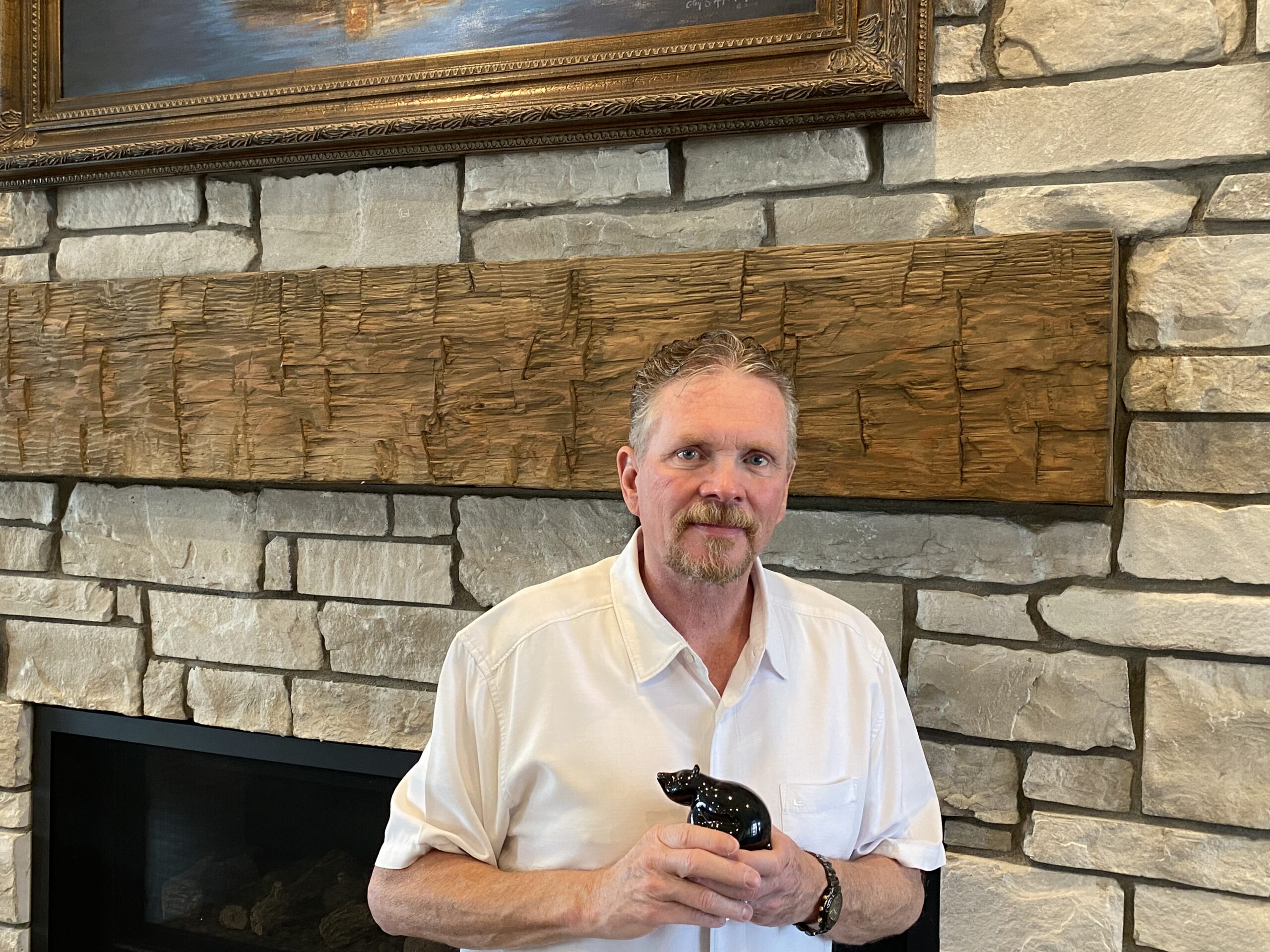
Steve Hitz with the bear that sits on his mantle

In my previous blog posts “Give Life a Chance,” part one and part two, I wrote about lessons learned and lived through our experience of losing our son to suicide.  I shared research, summaries, and ideas that our son wrote through his journal entries.  This final part is a closing chapter to these thoughts on our experience, though our research and learnings continue. 

I’ve scoured my son’s journals—mesmerized by his deep thinking and thoughtful outlook on life’s adventures.  From his recorded experiences, including his travels abroad, he really “found” himself. I stand in awe of the man he is.  It’s been nine months now since our boy’s passing.  

Part of his ashes were melted/molded into the symbol of his nickname “Bear” that sits atop our mantle.  Sometimes I bring him down and kiss him—imagining the bear hug he gave like none other.  As I often read beneath the mantle, I imagine him with me as I ponder life, picture where he now is in my mind, and sometimes have a nice chat with him.  I believe I hear him in the “conversation” and see him smiling upon me.  He knows I miss him so, and I sense he does the same.

Someone asked me recently, “Does it ever get better?”  The simple answer is “Not really.”  Yes, the miracle of healing has occurred in different ways for each family member, but the pain of his loss is constant.  I live with it because I want to.  It’s my way of always feeling near him.  The wave of sadness comes in sets, just like the ocean waves.  Some days I’m wading in the shallow water, sun on my face and reliving the joyous memories; other times I’m gob smacked by waves of emotion and loss.  That’s OK, the ocean keeps moving—sometimes small waves, sometimes large ones, but always cleansing in its own way.

Here are a few of ideas that have come to me on suicide ideation. Perhaps you can build upon these in developing your own thoughts.

  1. Don’t ask HOW.  You don’t need to know how a person died by suicide.  Asking them to relive the cause, can activate very real PTSD and cause pain unimaginable. You don’t need to know the cause in order to love, mourn, and embrace.  It’s just insensitive to ask, even though the question obviously didn’t seek to harm—so don’t.
  2. Don’t cast judgment.  I grew up in an era where suicide was cast as evil.  It’s NOT.  It’s simply the last resort of a lonely and anguished soul—almost always due to issues associated with mental illness.  As survivors of loved ones who leave the earth in this manner, our lot is simply to love.  Nothing else. Just love.
  3. Avoid advice-giving.  Those who participate in grief counseling and other such helpful venues learn to stick with statements that avoid advice-giving.  Share the air and listen intently to those grieving.  You have no obligation to “solve” a situation—just be.  Also, keep conversations shared with you by those who are grieving confidential.  They are sharing with you because they trust you.  Don’t ruin that trust.  It can be harmful on many levels.
  4. There are no “grief wars.”  No one’s loss is better or worse than another’s.  Hold space for everyone’s stories and experiences without a need to compare.
  5. Joy and sadness are not mutually exclusive.  Be willing to welcome laughter as much as tears.  You can be sad and still joyous, and joyous and still sad.
  6. Know that their spirit and essence live on.  I have the good fortune of mingling with many other faiths and faith leaders through our charity work.  I am always buoyed by rubbing shoulders with believers of any kind.  My faith beliefs differ from many of my friends and associates, but we ALL share the idea that our spirits live on. So it is.
  7. Live with intention.  In a major study of young people by Springtide National Research, their survey revealed 71 percent of young people say it is important to make intentional time and space to activate the imagination.  It’s so important to not live a life of simply checking boxes.  Rather, take the time to ponder and imagine.  Where this leads is only good.
  8. Be authentically you.  Someone once told me, “just be you,” everyone one else is taken.  Those who suffer with a feeling of not belonging are often pushed further into this abyss by those trying to help them, but are doing so from their need to check their own box.  Just be you.
  9. LOVE LIVES ON! Though you can’t bring them back, know that for everyone connected, including the one who died by suicide, LOVE LIVES ON!

The number one epidemic in the world is loneliness.  Especially in the rising generations, many are lonely, socially isolated, and stressed.  The Ford Motor Company 2020 Trends report identified loneliness as one of the most pressing issues confronting society now and for the foreseeable future.  Their study found a lack of trust in relationships which removes the bedrock of trust, which also increases anxiety as well. 

One significant antidote to loneliness is having a sense of belonging.  This “belongingness” is not a matter of where, but rather, who.  Family, friends and caring adults are the fountain of belongingness.  When our son was in his last trying months, he pushed his family and friends away, trying to shield his pain.  Don’t allow that to happen. Push back and in. Understand that your authentic and loving relationship requires work, and that work establishes belongingness for everyone—especially those who suffer. 

Consider these three levels of the belongingness process:

I am noticed.  There is not a living person on the planet who doesn’t have a need to be noticed in some way, sometimes.  How can we take the time to engage our loved ones, recognize them authentically, and celebrate their lives continuously?

I am named.  If you are like I am, when I meet someone new, I frequently forget their name, especially if my interaction is a one-time event.  I’ve taken to really trying to know someone by their name, even if I have to ask a couple of times to remind me what their name is.  Then I often write it in my notebook, so I have less of a chance of forgetting.  I can’t tell you how many times those supposedly one-time introductions have blossomed over time simply because I took the time to know their name.

I am known.  When someone is noticed and then their name is known, they feel like their personhood matters—at least to that person who is present and remembered.  We don’t need to be known to have any type of status.  If it’s a pride thing to be noticed, it’s simply not authentic.  Authentic people don’t appreciate fake status.  If you count on being known by the title on your business card, you won’t really be known at all.  But if we are known because of our authenticity, then we are on the road to some recovery from loneliness.

I’m not proposing any of these ideas for what has been, rather they are presented with the hope of what might be.  I’ll continue to walk on my beach of grief, basking in what once was with my hope of what might be—not only for my relationship with my son who has passed, but also for the relationships of belongingness I am reinventing for my family, friends and associates. Those I love.